
Florida Poly Online
STEM Education without Boundaries
Florida Polytechnic University provides innovative fully online master’s programs designed for students seeking flexible, career-focused STEM education.
Online Programs
Florida Poly Online provides innovative online opportunities designed for students seeking flexible, career-focused STEM education.
Online Programs
Florida Poly’s online Master of Science in Engineering Management (MSEM) program prepares engineers and technical professionals to become effective leaders in high-tech industries.
Online Course Types
- Fully Online Courses allow students to complete coursework remotely through interactive learning environments, virtual collaboration, and flexible scheduling.
- Asynchronous course options
- Interactive multimedia learning materials
- Mobile-friendly course access
- Faculty support and virtual office hours
- Hybrid Courses combine online instruction with scheduled in-person learning experiences, creating a flexible and collaborative academic environment.
- Combination of online and face-to-face learning
- Enhanced faculty and peer interactions
- Hands-on and collaborative activities
ONLINE RESOURCES FOR
Students
Tips for Success: Empower Your Online Learning Journey
- Know your advisor and build a strong relationship with them – your success is their goal!
- Register for classes on time or early to secure your spot and avoid late fees.
- Learn more about effective study habits and what works best for you.
- Communicate regularly with your instructors, especially if you are struggling.
- Form a study group in class for your classes.
- Florida Poly has a wide variety of support and resources. Please check the student support and resources section.
- Share your voice! – Complete your course evaluations at the end of the semester and your Graduation Survey. Your voice matters!
Student Support and Resources
Florida Poly Online is committed to student success by providing flexible learning opportunities and personalized support services. Through dedicated faculty, academic advising, and career-focused resources, students are empowered to thrive in online environments while preparing for success in today’s rapidly evolving industries.
Explore Student Success Support and Resources
- Academic Services
- Course Registration
- Grades
- Transcript Request
- Administrative Support
- Graduate Studies Office
- Registrar’s Office
- Student Business Services
- Financial Aid
- Bookstore
- Technology Support
- Canvas Support
- IT Help Desk
- Online Apps
- Student Affairs
- Career Services
- CARE Services
- Wellness Resources
- Disability Resources
- Veterans and Active-Duty Military
Student Identity for Online/Distance Education
Florida Polytechnic University is committed to ensuring the integrity and quality of its online and hybrid learning experiences. In accordance with federal regulations, the University verifies that the student who registers for an online or distance education course is the same student who participates in and completes the course.
How We Verify Student Identity: Students access online courses and University systems using their unique Florida Poly credentials through the University’s secure authentication process. Identity verification measures may include:
- University-issued username and password
- Single Sign-On (SSO) authentication
- Multi-Factor Authentication (MFA)
- Secure access to the Learning Management System (LMS)
- Online or in-person proctored examinations, when required
- Additional identity verification methods for selected courses or assessments
Depending on the course, instructors may use one or more of these methods to help maintain academic integrity.
Student Responsibilities: Students are responsible for protecting the confidentiality of their university login credentials and authentication devices. Sharing usernames, passwords, or allowing another individual to complete coursework or assessments on a student’s behalf is prohibited and may constitute a violation of the Florida Polytechnic University Academic Integrity Policy and Student Code of Conduct.
Privacy of Student Information: Florida Polytechnic University is committed to protecting student privacy. Any information collected as part of the identity verification process is used solely for educational and administrative purposes and is safeguarded in accordance with the Family Educational Rights and Privacy Act (FERPA) and other applicable laws and University policies.
Additional Information: At this time, Florida Polytechnic University does not charge a separate fee specifically for student identity verification in online or distance education courses.
Questions regarding online learning technologies or student authentication processes may be directed to the Office of Instructional Technology and Design or the Office of Information Technology Services.
ONLINE RESOURCES FOR
Instructors
Empowering Faculty for Excellence in Online Teaching
Florida Poly Online is committed to supporting faculty in the design and delivery of engaging, high-quality online and hybrid learning experiences. The Instructor Resources page provides faculty with access to tools, training, instructional support, and best practices that promote student success and innovative STEM education.
Online/Hybrid Teaching at Florida Poly
Online and hybrid instruction at Florida Polytechnic University is built on innovation, engagement, accessibility, and student-centered learning. Faculty are supported through collaborative partnerships with instructional designers, technology specialists, and academic support teams to create effective digital learning experiences.
Faculty teaching online and hybrid courses are encouraged to incorporate:
- Active learning strategies
- Clear course organization
- Engaging multimedia content
- Regular instructor presence
- Accessible learning materials
- Real-world and applied STEM learning experiences
Faculty Support Services
The Office of Instructional Technology and Design partners with faculty to create engaging and effective online and hybrid courses. Instructional designers assist with:
- Course development and redesign
- Online course quality standards
- Learning activity design
- Assessment strategies
- Multimedia integration
- Accessibility compliance
- Canvas course organization
Services
- One-on-one consultations
- Course reviews and feedback
- Course templates and resources
- Multimedia support
- Faculty training workshops
Faculty Development Training
Online/Hybrid Teaching Certification
Florida Poly offers professional development opportunities to prepare instructors to teach effectively in online and hybrid learning environments.
Training Topics
- Setting clear expectations and policies
- Providing timely and meaningful feedback
- Online presence
- Teaching in the virtual classroom
- Integrating multimedia
- Active and interactive learning
- Communication in online teaching
Online/Hybrid Learning Course Approval Process
- The Department chair selects courses to be taught as online/hybrid
- The department chair will identify the Subject Matter Expert (SME)
- The instructor or SME will complete the Online/Hybrid Request Form
- The provost or designee approves course offering
- The department chair will identify the instructor of the course (note: The SME and Instructor does not have be the same person) and fill out the Teaching Online Form
- The Instructional Technology and Design team will enroll the instructor into the Teaching Online Certificate course on Canvas
- The instructor will need to complete the Online Teaching Certification before they are allowed to teach the course
Course Design and Planning Stage
- The SME will be assigned an instructional designer to work with them during this conversion.
- The SME will complete the Course Planning Worksheet
- Overview and Outcomes
- Modules Guides
- Required Readings
- Assignments
- Assessments
- The SME will complete the course outline
- The Instructional Designer will build the course modules in Canvas
- Video Content will be created by the SME
- The Instructional Designer will assist in creating Learning Objects
- The ID will ensure that the course is aligned with the Quality Course Standards
- The ID will ensure that the course is ADA compliant
- Final review by ID
- Approval form will be forwarded to the Department Chair and the Registrar
- The course is listed in the course catalog by the registrar
- Course is taught
- Students will fill out the end of course survey
- Instructional Designer will review the course to ensure that the instruction meets the Quality Matter standards.
Faculty Incentives for Online Course Development and Conversion
To support the expansion of high-quality online learning, the university provides incentives for faculty who develop or convert courses for online delivery. These incentives recognize the time and effort required to design courses that meet institutional quality standards and support student success. This compensation is awarded per course. A faculty member developing more than one course at the same time will receive compensation for each. The course developer (Subject Matter Expert (SME) does not have to be the instructor of the course. If you are converting a course to both an online and hybrid format, at the same time, the compensation structure will follow the online course parameters.
New Online Course Development:
A new online course is defined as a course that has not previously been taught at the university in any modality.
Compensation Structure:
- Online Course
- $2,000 – Course Development Stipend: Awarded to the Subject Matter Expert (SME) for developing the new course.
- $1,000 – Quality & Teaching Certification Stipend: Awarded to the Online Instructor after:
- The course has been taught for the first time, and
- The course has successfully passed Quality Matters standards, and
- The instructor has successfully completed the Teaching Online training course.
- Total Potential Compensation: $3,000
- Hybrid Course
- $1,000 – Course Development Stipend: Awarded to the Subject Matter Expert (SME) for developing the new course.
- $500 – Quality & Teaching Certification Stipend: Awarded to the Online Instructor after:
- The course has been taught for the first time, and
- The course has successfully passed Quality Matters standards, and
- The instructor has successfully completed the Teaching Online training course.
- Total Potential Compensation: $1,500
Existing Course Conversion to Online:
A course conversion refers to converting a course that has previously been taught at the university into a fully online format.
Compensation Structure:
- Online Course
- $1,000 – Course Conversion Stipend: Awarded to the Subject Matter Expert (SME) responsible for converting the course.
- $1,000 – Quality & Teaching Certification Stipend: Awarded to the Online Instructor after:
- The course successfully passes Quality Matters standards, and
- The instructor has successfully completed the Teaching Online training course.
- Total Potential Compensation: $2,000
- Hybrid Course
- $1,000 – Course Conversion Stipend: Awarded to the Subject Matter Expert (SME) responsible for converting the course.
- $500 – Quality & Teaching Certification Stipend: Awarded to the Online Instructor after:
- The course successfully passes Quality Matters standards, and
- The instructor has successfully completed the Teaching Online training course.
- Total Potential Compensation: $1,500
Course Prioritization:
Because institutional resources are limited, courses will be prioritized as follows:
- Courses within approved Online Programs will receive first priority for funding.
- Department-requested online courses outside of online programs may be approved if funding remains available.
Funding for Non-Priority Courses:
If a requested course conversion does not align with institutional goals for online program development or online course development, but has been approved by Academic Affairs for an alternative modality, the following will apply:
- The course may still be developed or converted to online.
- However, Academic Affairs will not provide incentive funding.
- In these cases, the department will be responsible for providing any faculty compensation related to course development or conversion.
- The course will still have to meet the Quality Matter standards.
Quality Requirements:
To receive the final incentive payments, courses must:
- Meet Quality Matters standards
- Be reviewed and approved through the university’s course quality review process
- Be taught by an instructor who has completed the Teaching Online training program
These requirements ensure that online courses meet institutional expectations for quality, accessibility, and student engagement.
Online/Hybrid Courses Redesign
- Online/Hybrid course will need to be redesigned every three years.
- Media and videos will need to be updated every three (3) years.
- If an instructor is no longer working with the university their media content will only be allowed to be used for one year following their departure.
Ownership of Course Materials
- Faculty Ownership: Faculty members retain intellectual property rights to course materials they create, including but not limited to:
- Lecture notes
- Syllabi
- Assignments
- Exams
- Multimedia content (e.g., videos, audio recordings)
- Materials posted on Canvas or other LMS platforms
- University Ownership and Shared Rights: The university may assert ownership or shared rights only when:
- The faculty member receives additional compensation for course development
- Materials are created under a specific work-for-hire agreement
- Substantial university resources (beyond standard support) are used
- Post-Employment Content Rights: Upon a faculty member’s departure, the university shall:
- The university can reuse their course content that has been created following the University Ownership and Shared Rights.
- Media/Videos produced for online/hybrid courses can only be used for one (1) year after the instructor’s departure
Complete the 1-20 Application Form
Complete the I-20 Application Form, email it to ISS@floridapoly.edu and include the following documentation:
Color Copy of Passport
Expiration date must be valid for at least six months beyond your stay in the United States (US).
Financial Evidence
You must verify you have the financial resources to cover the total estimated costs listed on this form and provide one of the acceptable financial evidence:
- Official bank statements or certified letters from a bank.
- Educational loan letter including terms and conditions (funds availability date and total loan amount).
- Signed copy of financial aid award letters (i.e., loans, scholarships, assistantships, fellowships).
- Sponsor Affidavits of Support and financial evidence from the sponsor(s).
- Support from a business account requires a recent bank statement from a business, an official bank letter indicating the name of individual(s) with signatory power, and an affidavit of support.
F-1 students seeking to study in the U.S. must provide proof of ability to afford all educational and living expenses ($40,282 USD). Immigration regulations require evidence of the source of funding; finances must be liquid assets available to cover the total cost of attendance (COA) for each academic year and until the completion of the academic program. Support can include financial aid, student, or sponsor funding. Sponsors may be a parent, relative, friend, government or scholarship agency, or a combination of any of the sponsor types listed. For more information, review our estimated tuition and fees.
Steps to Obtain Your Visa
- Review your I-20 Form issued by Florida Poly’s Designated School Official.
- Pay the SEVIS fee – Form I-901.
- Complete the DS-160 Online Nonimmigrant Visa Application.
- Schedule an appointment for a visa interview at the U.S. Embassy or Consulate. Bring the following to the interview:
I-20 Form
Passport
A copy of your acceptance letter
Proof of available funds
DS-160 confirmation page
Proof of SEVIS payment
Note: The I-20 form is for the F-1 Visa student. An international student approved for an educational exchange program will apply for a J-1 Visa and complete the DS-2019 application provided by the program sponsor after being entered into SEVIS. Spouse and children will need to apply for F-2 and J-2 dependent visa.
Compliant Resolution
National Council for State Authorization Reciprocity Agreements (NC-SARA)
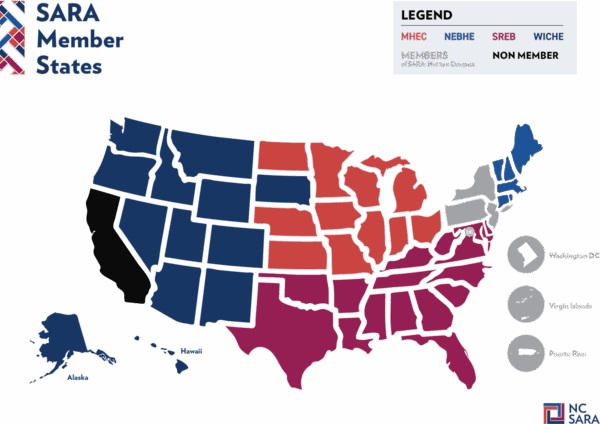
State of Florida – State Authorization Status
Florida Polytechnic University is an approved member of the National Council of State Authorization Reciprocity Agreements (NC-SARA). The State of Florida became a SARA state in 2017 following the creation of the Postsecondary Reciprocal Distance Education Coordinating Council.
Prospective students interested in enrolling in distance programs related to professional licensure in their home state should still check with their appropriate state licensing agency prior to applying for, or beginning, a Florida Polytechnic University program.
NC-SARA Institutions: https://nc-sara.org/directory/
Online/Distance State Authorization Process
The United States Department of Education regulation 4 C.F.R.§ 600.9(c) requires each state to apply for and receive authorization to provide online/distance education programs to out-of-state students. The authorization requirements, as well as the application processes, vary on a state-by-state basis. The Office Instructional Technology and Design works with faculty and staff across all departments within Florida Polytechnic University who have or may establish online programs to comply with this regulation. Out-of-state students who are considering applying to a professional program should contact the licensing agency or board in their state prior to enrollment. Florida Polytechnic University cannot attest to whether a program meets licensure requirements in a student’s state of residence.
The Office of Instructional Technology and Design work to support the National Council for State Authorization Reciprocity Agreements (NC-SARA) in identifying and updating an index of state legislation and application requirements. Now adopted, NC-SARA establishes standards for reciprocity agreements that colleges and universities from around the country meet and provides the advantage of a singular application to provide online/distance education in all 50 states.
Florida Polytechnic University is accredited through the Southern Association of Colleges and Schools Commission on Colleges (SACSCOC). SACSCOC is an institutional accrediting agency recognized by the U.S. Department of Education. This federally recognized body provides assurance to students, parents and all stakeholders that Florida Poly meets clear quality standards for educational and financial performance. In addition, Florida Poly is required by the U.S. Department of Education to provide all current and prospective students with the contact information for their respective state agency in the event they wish to file a complaint.
Student Complaint Process
Every Online distance learning program has a process for and will make every attempt to resolve student complaints within its academic and administrative departments. If an issue cannot be resolved at the departmental level, students have the right to file a complaint with the Office of the Ombuds: https://floridapoly.edu/about/departments/ombuds/ or by utilizing the “Reporting a Concern” form: https://floridapoly.edu/report/
The university is required to provide both current and prospective students with contact information for filing complaints with it accrediting body and the appropriate state agency for handling complaints in a student’s resident state. Florida Polytechnic University is accredited by the Southern Association of Colleges and School Commission on Colleges (SACSCOC).
Contact the Commission on Colleges for questions regarding accreditation of Florida Polytechnic University:
Southern Association of Colleges and School Commission on Colleges
1866 Southern Lane
Decatur, GA 30033
404-679-4500
In the event the student feels the grievance was not managed properly by the institution, the student may submit his or her complaint to the following:
State University System of Florida Board of Governors
Office of Inspector General and Director of Compliance
325 West Gaines Street, Suite 1614
Tallahassee, FL 32399-0400
Website: www.flbog.edu
Email: Info@flbog.edu
Out-of-state distance learning students, who have completed the internal grievance process and the applicable state grievance process, may appeal non-instructional complaints to the FL-SARA PRDEC Council. For additional information, please visit the FL-SARA Complaint Process website, https://www.fldoe.org/sara/student-concerns.stml.