
Plastic pollution has become a widespread global problem, with microscopic particles in the water that can slip into the human body without notice. For decades, scientists have struggled to detect these microplastics and nanoplastics quickly and affordably. Researchers at Florida Polytechnic University are working on a new approach that could change that.
Dr. Ajeet Kaushik, an associate professor of chemistry, and students Riley Orr and Justin Sanchez Almirola developed a solution based on electrochemical sensing, a technology that uses chemical reactions to detect and measure the concentration of specific materials in different environments.
Their innovation earned a U.S. patent and was published in the international journal Sensors and Actuators A: Physical. The topic is also an extension of Kaushik’s ongoing research.
“Right now, there is no way to detect this type of pollution on the spot,” Kaushik said. “But our sensor works in the field, and within minutes just a drop of water tells you if microplastics are there and at what level.”
The severity of the issue is immeasurable, said Kaushik, who has been recognized on Stanford University’s prestigious list of the world’s top 2% of scientists since 2021.
According to the U.S. Environmental Protection Agency, Microplastics range from about the size of a pencil eraser down to particles so small they resemble the width of a red blood cell. Nanoplastics shrink even further into the nanometer scale, far too small to see without powerful microscopes.
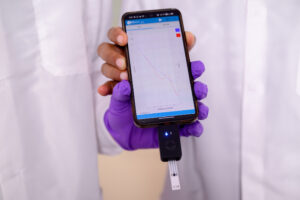
The innovative new sensor uses a specially treated electrode strip connected to a small reader. After a drop of water is added, the system looks for plastics such as polystyrene and turns that into an electrical signal the user can see on a smartphone.
“We have needed an easy way to measure microplastics in any body of water because what scientists have been doing takes advanced machines and trained technicians,” said Orr, a senior majoring in electrical engineering.
Orr and Almirola ’25, a mechanical engineering alum now pursuing his master’s in the same discipline, stepped up to assist Kaushik with the project with support from other researchers. Almirola and Kaushik earned inventor status on US Patent No. 12,523,590 B1, “Sensing Plastics with Electrode Sensor to Monitor Fluid Environments.”
Kaushik said that another patent application and paper are under review, with Orr and senior mechanical engineering major Andrea Lee to be included as inventors on the patent.
Contact:
Lydia Guzmán
Director of Communications
863-874-8557