Performing maintenance outside the International Space Station is a complex and risky task that requires astronauts to wear bulky space suits and conduct spacewalks to repair vital components like the station’s protective multi-layer insulation.
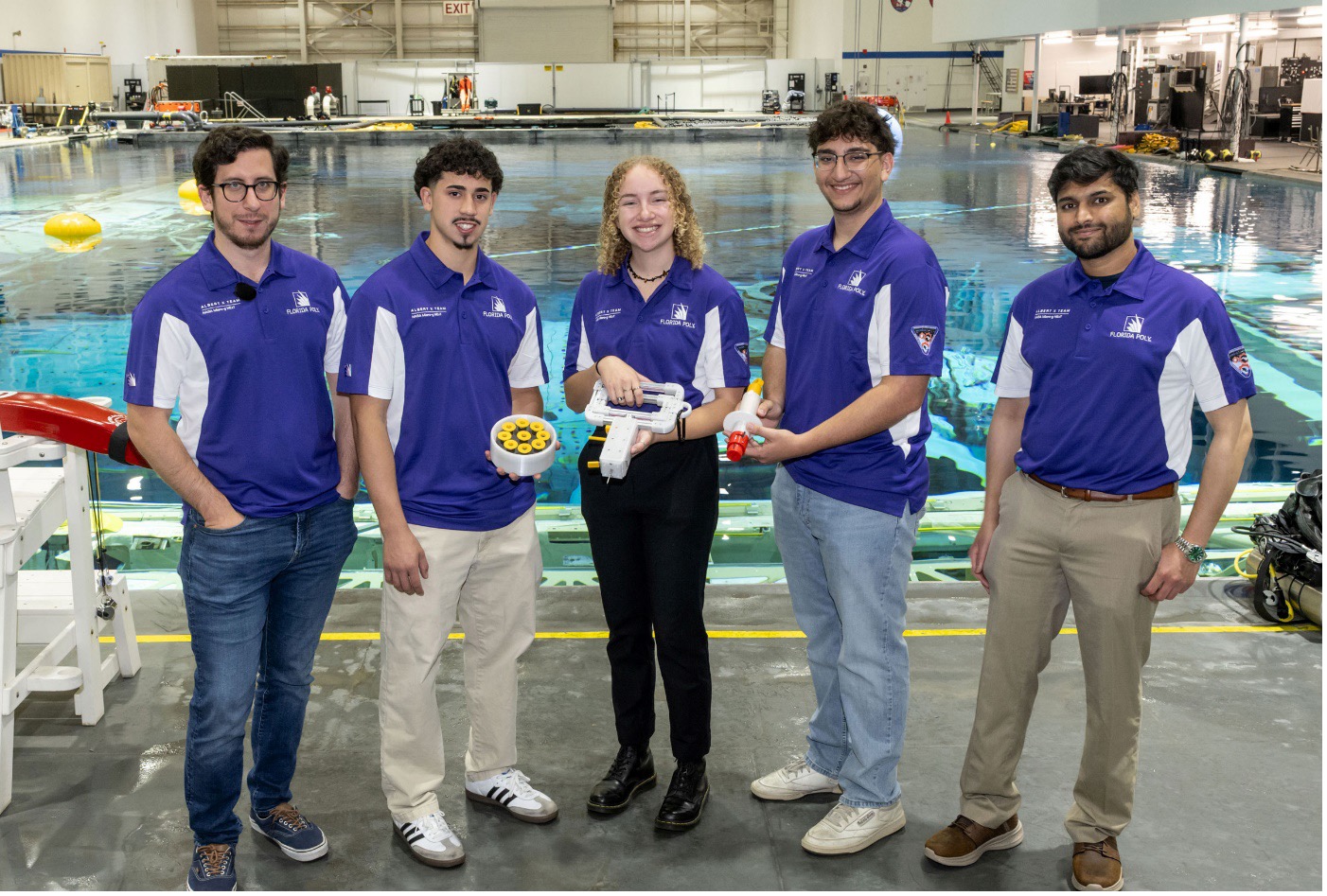
Now, a team of mechanical engineering students from Florida Polytechnic University has stepped up with a promising new idea. The group of rising seniors designed a tool aimed at simplifying a common challenge faced by astronauts: securing two overlapping pieces of a specialized fabric-like material when only one side is accessible – mirroring real-world conditions outside the ISS.
“If there was something wrong with the fabric and it needed to be repaired, our device would essentially put a new piece of fabric on top,” said David Chazbani, from Parkland, Florida. “Our NASA mentors gave us a lot of good feedback throughout the project about things like piercing the fabric and how comfortable the tool will be for an astronaut to use with their gloves.”
The creative device has the potential to improve the way astronauts conduct repairs, reducing risks and increasing effectiveness during spacewalks on the 25-year-old orbiting laboratory.
The effort was part of NASA’s highly selective Micro-g NExT Challenge, which tested collegiate teams’ designs at the agency’s Johnson Space Center in Houston, Texas, in early June. This was Forida Poly’s first time participating in the event, joining only 16 other schools from across the country, including Virginia Tech and Embry-Riddle Aeronautical University.
NASA divers tested the team’s device underwater at the agency’s Neutral Buoyancy Lab to simulate conditions in space – and the results were nothing short of perfection. Florida Poly’s device was the only tool to successfully complete the challenge.
“The testers said that our device was the closest thing they’ve seen to something they would actually create and design for themselves to use, and that was the greatest compliment we could receive,” said Eduardo Jirau, the team’s lead.
As part of the yearlong challenge, the team will submit a final report on their innovative design to NASA in July.
Contact:
Lydia Guzmán
Director of Communications
863-874-8557