
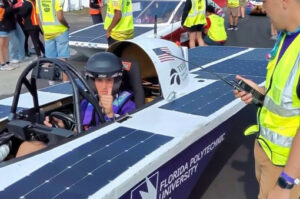
Florida Polytechnic University’s Phoenix Racing solidified its position among elite international competitors with a second-place U.S. finish at the Electrek Formula Sun Grand Prix this week, securing a spot in the upcoming Elektrek American Solar Challenge. The University of Washington was the top U.S. team at the event.
Phoenix Racing placed fifth overall in the international competition.
In its third appearance at the three-day event, Phoenix Racing went head-to-head with world champions, record-setters and leading programs from around the world.
“We’re proud to be part of this competition and to be making Florida Poly history,” said Caleb Smith ’26, the team’s president.
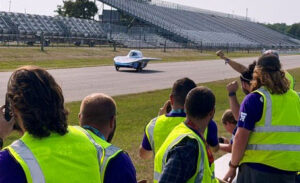
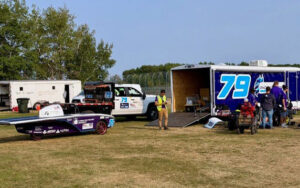
Phoenix Racing completed 235 laps, covering 728 miles at an average speed of 35 to 40 mph to finish at the competition at Brainerd International Raceway in Brainerd, Minnesota.
The team finished 30 laps ahead of sixth-place University of California, Berkeley and 44 laps ahead of seventh-place Stanford University. Both programs have been among the nation’s premier collegiate solar racing programs for more than three decades.
“Our performance showed how far we’ve come as a team and was beyond what we accomplished with last year’s third-place finish,” said Smith, a recent mechanical engineering master’s graduate who will return this fall as a visiting instructor. “We overcame challenges and stayed competitive against some of the best teams in the world.”
Phoenix Racing’s performance in its solar car, Spark MK 2.5, exceeded the winning lap totals from each of the past two Formula Sun Grand Prix competitions: the University of Illinois with 223 laps in 2024 and ÉTS Montreal with 215 laps in 2023.
International powerhouses claimed the top three positions in this year’s competition: ÉTS Montreal with 347 laps, TU Delft of the Netherlands with 319 laps and KU Leuven of Belgium with 300 laps.
“In 2022 and 2023 we built a cheap prototype out of Amazon parts, never raced it and learned the fundamentals,” said Dr. Matt Bohm, the team’s lead faculty advisor. “In 2024 we built our first competition car, Spark MK 1, from scratch and finished seventh. In 2025 we built Spark MK 2 and finished third. This year, we refined that design with Spark MK 2.5 and qualified for the American Solar Challenge on the first day.”
The American Solar Challenge begins Saturday and is a grueling eight-day, 1,500-mile cross-country race from Minneapolis, Minnesota, to Amarillo, Texas. The event tests vehicle endurance, efficiency and team strategy.
“I’m proud that our team was able to qualify so quickly,” Smith said. “The entire team is excited to be the first team in Phoenix Racing’s history to compete in the American Solar Challenge.”
The Formula Sun Grand Prix and American Solar Challenge bring together top collegiate engineering teams from around the world, giving students the opportunity to design, build and race solar-powered vehicles.

Contact:
Lydia Guzmán
Director of Communications
863-874-8557