
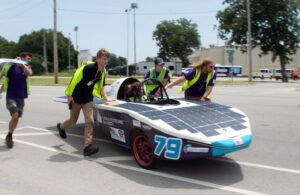
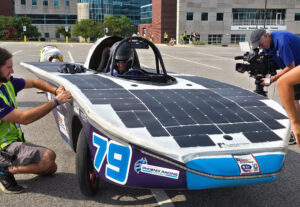
Phoenix Racing crossed the finish line to place third among U.S. teams and sixth overall in its debut at the biennial Electrek American Solar Challenge on Saturday, Aug. 1.
The Florida Polytechnic University team finished the eight-day, 1,500-mile cross-country race just behind the University of Washington and Stanford University, the only two American programs to score higher at fourth and fifth place.
At the front of the global pack, internationally renowned teams KU Leuven of Belgium, TU Delft of the Netherlands and ÉTS Montréal of Canada secured the top three overall spots. Florida Poly’s position behind these long-established teams paved the way for it to claim its sixth-place international finish and standing as a top-tier U.S. program.
Despite being one of the youngest universities in the competition, Phoenix Racing excelled on the open road, outperforming long-established programs, including the University of California, Berkeley, and the University of Florida.
The team covered 1,248.1 official miles and recorded just 11 penalty miles, one of the cleanest driving records in the field.
“The team’s performance was stellar. Everyone worked together like we had practiced for months, and the car performed even better than we expected,” said Caleb Smith ’26, the team’s president. “It’s an honor to be able to compete alongside these other amazing teams and see their capabilities.”
That collaborative spirit helped the team navigate unpredictable traffic and punishing weather conditions along the multi-state route.
“The best part of this experience has been seeing that all of our hard work and time building this car has paid off,” said Cody King, a senior majoring in mechanical engineering.
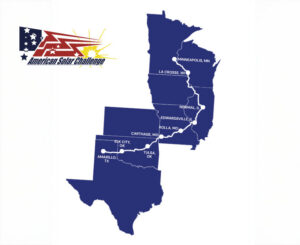
Florida Poly’s showing came right after the team earned second place among U.S. teams — and fifth overall — in the qualifying Electrek Formula Sun Grand Prix on July 23 in Brainerd, Minnesota. The track race drew 49 teams, 19 of which qualified for the grueling cross-country race from Minneapolis, Minnesota, to Amarillo, Texas. Fourteen crossed the finish line.
“As a faculty member, you spend a lot of time teaching concepts in the classroom and hoping students can apply them later, and this week, I got to watch that happen in real time,” said Dr. Elisabeth Kames, the team’s faculty advisor. “Every day brought a new challenge, and instead of looking to the advisors for answers, the students worked through the problems themselves.”
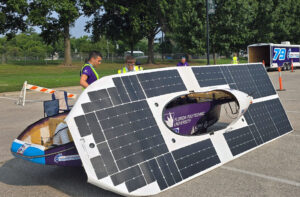
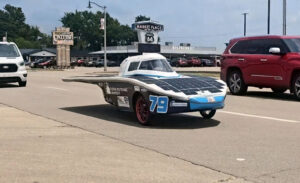
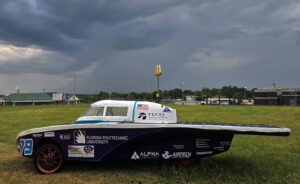
The two solar races underscored that the team’s engineering overhaul of their solar car, Spark MK 2.5, was successful, demonstrating the car’s mechanical reliability and structural durability on public roads and highways.
Phoenix Racing already has its sights set on defending its track-race success at the 2027 Formula Sun Grand Prix. The next cross-country Electrek American Solar Challenge race will be in 2028.
“Next year’s car is going to be a complete optimization of this one with more refined aerodynamics, reduced weight, better vehicle dynamics and much more,” said Smith, a recent mechanical engineering master’s graduate who will return to Florida Poly this fall as a visiting instructor. “We have had the opportunity to see what other teams have been able to accomplish, so we are very excited to apply some of that new knowledge going forward.”
Race Results
Single-Occupancy Vehicle Class
- KU Leuven, Belgium: 2,671.2 miles
- TU Delft, the Netherlands: 2,535.5 miles
- ÉTS Montreal, Canada: 2,443.9 miles
- University of Washington: 1,749.4 miles
- Stanford University: 1,424.8 miles
- Florida Polytechnic University: 1,248.1 miles
- University of Waterloo, Canada: 1,201.1 miles
- University of California, Berkeley: 1,127.4 miles
- Illinois State University: 776.3 miles
- Western Michigan University: 637.3 miles
Contact:
Lydia Guzmán
Director of Communications
863-874-8557