
Researchers at Florida Polytechnic University’s Advanced Mobility Institute are beginning a new phase in their work on autonomous vehicle testing and verification. The research is shifting gears from software to hardware testing at a new simulation facility on campus, funded in part by a $350,000 grant from the National Science Foundation.
The centerpiece of the project – a tricked-out, autonomous Ford Fusion sedan – recently arrived at Florida Poly. The car is equipped with sophisticated electronics and has been transformed into a drive-by-wire autonomous test vehicle.
“Drive by wire means you can control the steering, acceleration, braking by electronic signals,” said Dr. Onur Toker, associate professor of electrical and computer engineering and one of the researchers. “If you put a computer in it, it becomes an autonomous vehicle test car.”
The autonomous Ford Fusion will eventually be put to work on Polytechnic Circle, the road encircling campus.
“Autonomous vehicles have computer systems that you can think of like a child – it needs time to mature, grow, and learn,” said Dr. AJ Alnaser, assistant professor of applied mathematics and researcher. “Once it learns enough, we have to test it. We have to be able to trust that we can give it a driver’s license and it can drive safely.”
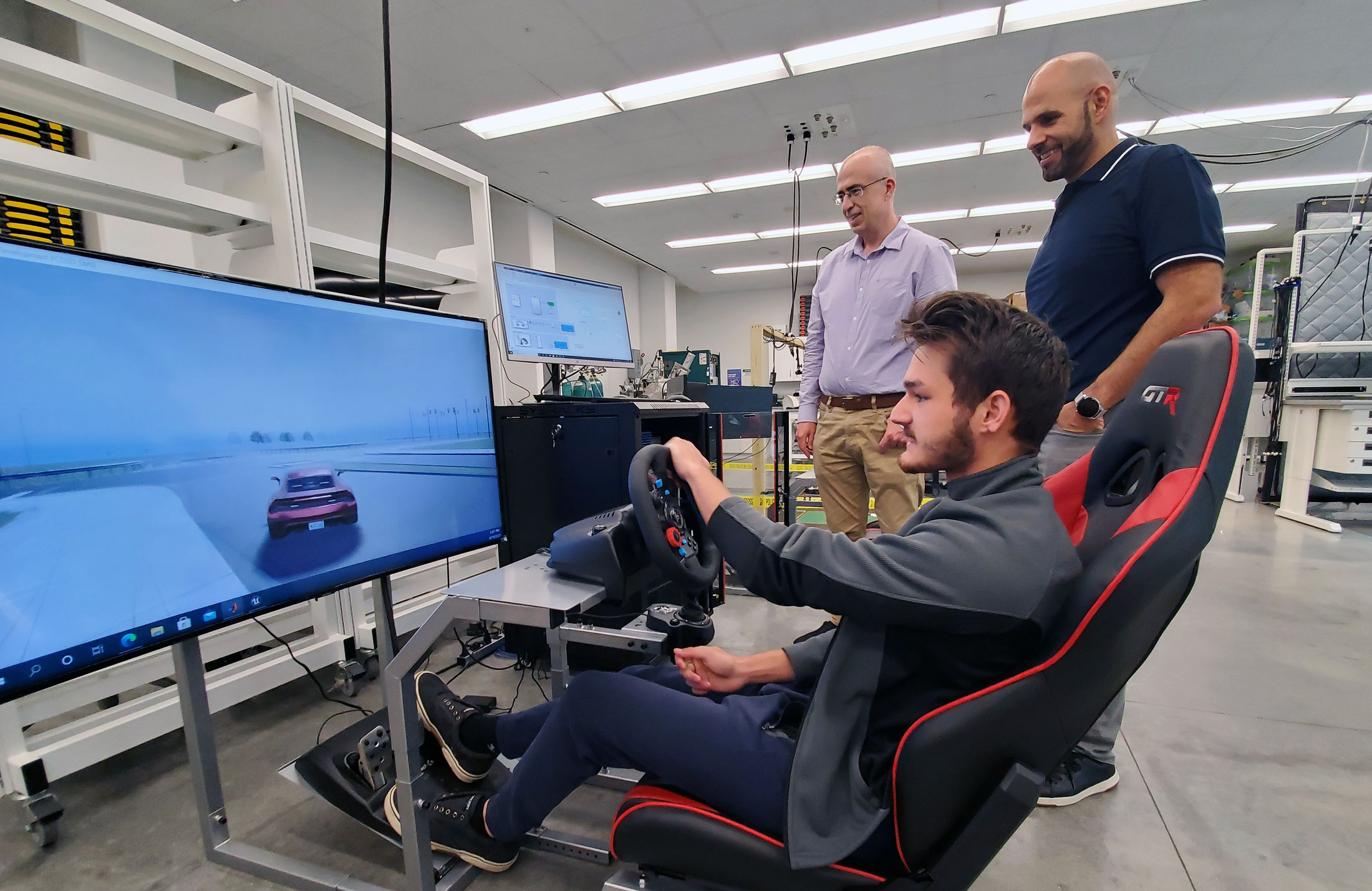
Meanwhile, inside the new simulation lab, researchers can emulate precise driving conditions and test whether a car’s programming responds as it should. The lab’s testing and verification equipment includes advanced computers connected to two lifelike driving simulators, complete with racing seats, steering wheels, pedals, and large monitor screens.
“It’s incredibly realistic,” Alnaser said.
Alnaser said testing and verification of connected autonomous vehicle (CAV) technology is a huge, multidisciplinary industry problem.
“We want to define what’s a safety measure for cars and then we want to go after how to make conditions as dangerous as possible in a simulation platform,” he said. “It’s cheaper and safer.”
Simulations can then go from the virtual world to the physical one with testing on the Ford Fusion.
Dr. Arman Sargolzaei, assistant professor of mechanical engineering at Tennessee Technological University, is working with Florida Poly researchers on the project. He served as a visiting faculty member to help advance the effort.
“CAVs will be used on roads in the future to transfer people and goods, and we need to make sure this technology is ready and safe in advance,” said Sargolzaei, whose Tennessee facility is focusing on security aspects while Florida Poly focuses on sensors and testing algorithms. “This new facility at Florida Poly allows faculty members and graduate students to develop, implement, and test their algorithms in realistic and safe environments.”
Contact:
Lydia Guzmán
Director of Communications
863-874-8557