
LAKELAND, Fla. – A team of researchers at Florida Polytechnic University is turning a disused golf cart into a solar-powered autonomous vehicle that will be used to advance cutting-edge research for years to come. The project is funded by the University’s Advanced Mobility Institute and will be used to support a $350,000 National Science Foundation award to develop a large-scale Hardware-in-the-Loop simulation facility for connected and autonomous vehicles (CAV).
“We are designing this in such a way that students can do research with it – it’s not just for demonstration,” said Dr. Arman Sargolzaei, director of the Advanced Mobility Institute, which focuses on the development and testing of autonomous vehicle technology. “We are making the code and applications available, so undergraduate and graduate students in the future can do research and implement different algorithms for different fields for autonomy, control systems, cybersecurity, power systems, and energy systems.”
The project is a marriage between the two critical and emerging fields of renewable energy and connected and autonomous vehicle (CAV) technology. Dr. Mohammad Reza Khalghani is leading the renewable energy part of the project.
Student researchers spent the spring semester repairing the broken golf cart, and began working on its high-tech transformation at the start of the summer term. They first developed a simulated golf cart for demonstrations and then recreated the simulations on the actual vehicle.
“It’s becoming more and more important to have smart ways of transporting people. Smart technology has become a lot bigger recently and it’s only going to increase,” said electrical engineering junior Eduarda Farias, an international student from Brazil who is a research assistant on the project. “Autonomous vehicles are one of the next technologies we are going to integrate into our lives.”
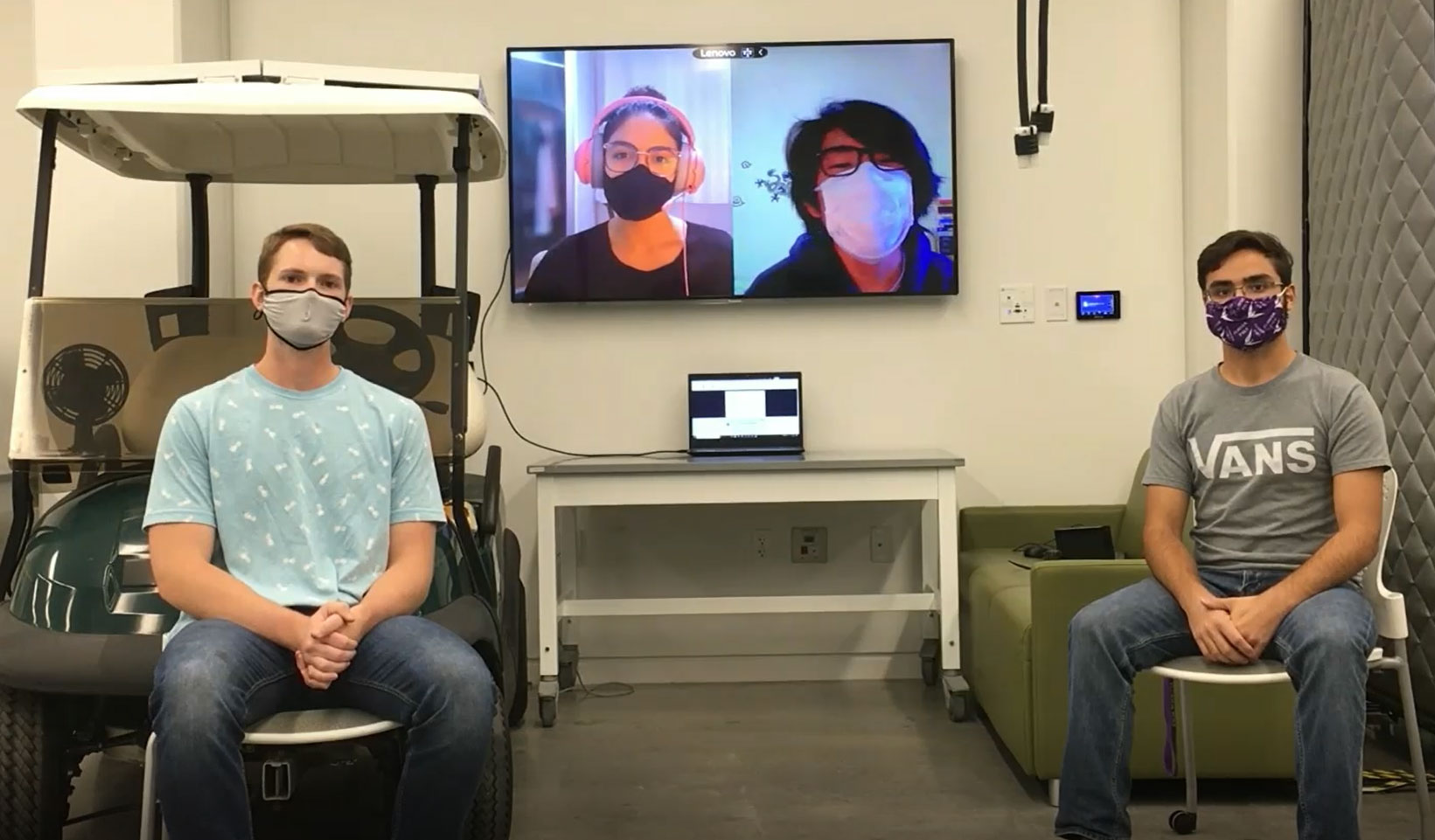
The team recently achieved a successful milestone by converting the cart into a drive-by-wire vehicle that can be controlled through a website. James Holland ’20, a research assistant on the project, said the cart is now similar to a big remote-controlled vehicle.
“Our demo went really well with the golf cart rolling forward at 50 percent acceleration and then backward before coming to a stop on its own. It followed the commands to a T,” said Holland, who earned his bachelor’s degree in computer science from Florida Poly in May. “It was awesome to see the payoff of all our work and see it run.”
The team plans to continue working on the vehicle both in person and remotely over the coming semester.
“The next steps will include working on path following and object avoidance algorithms and programming – really developing the autonomous part of the golf cart,” said Farias, who is working remotely this summer.
“It’s been amazing seeing the golf cart actually run. I love that I could walk into a professor’s office and become part of a really fun project like this.”
Contact:
Lydia Guzman
Director of Communications
863-874-8557