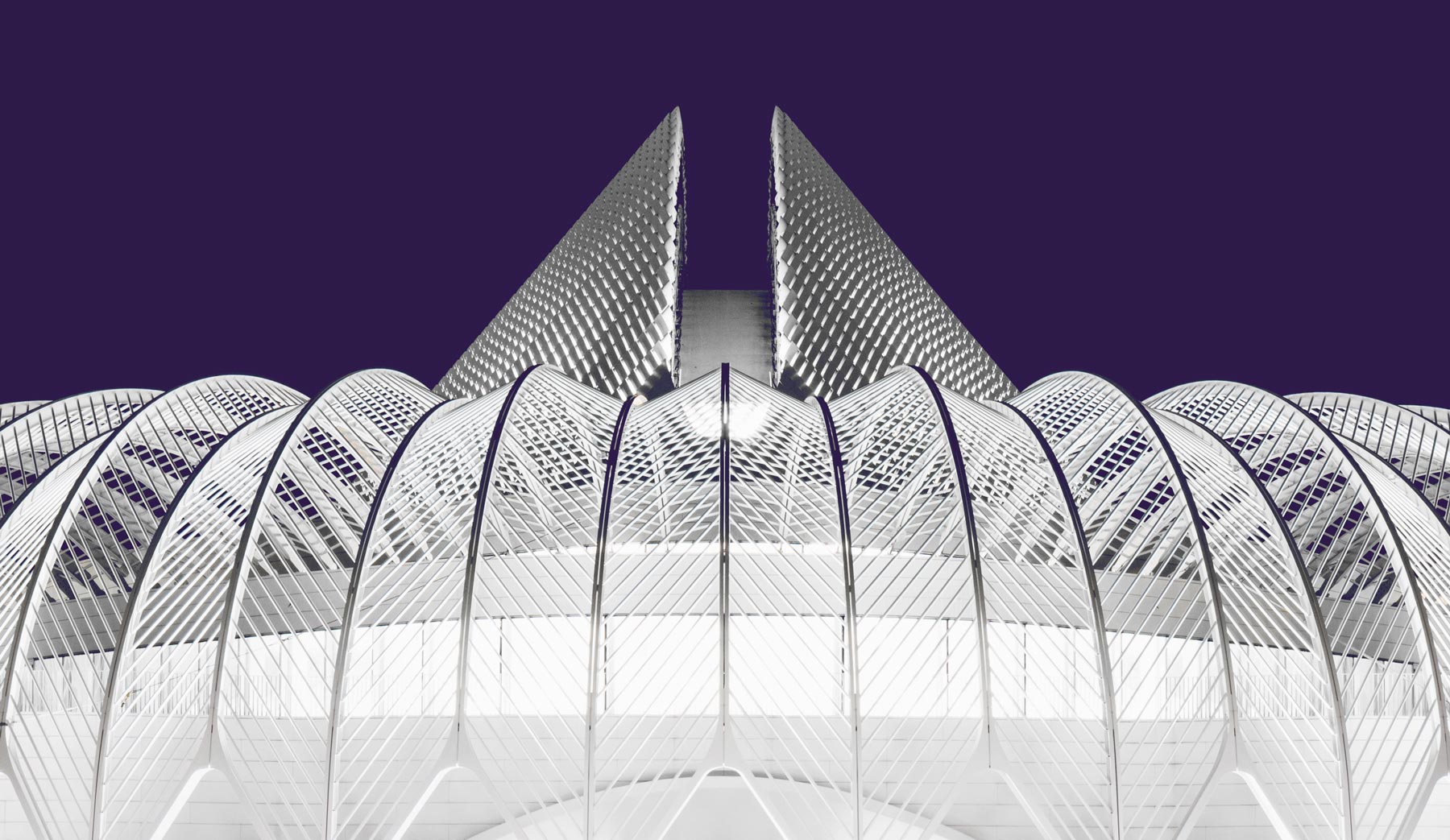
From the lawn outside the Innovation, Science, and Technology Building, a group of Florida Polytechnic University students make contact and build connections with people across town, across the country, and around the world.
Radio Frequency (RF), a committee of the Florida Poly chapter of the Institute of Electrical and Electronics Engineers (IEEE), is dedicated to bringing as many students as possible into the world of amateur radio.
“Radio takes everything you ever learned or will learn in electrical engineering and applies it to the maximum,” said electrical engineering senior Vlad Fomitchev, chair of RF. “It really requires you to push the limits of what can be done.”
He highlighted the work RF was doing outside the IST with a large antenna and portable transceiver as an example.
“A radio like the one we have is operating on both extremes of trying to amplify the very weak signals it picks up as much as possible and immediately after when you want to transmit, it amplifies your signal to be as strong as possible,” Fomitchev said. “You’re working with both very small and very large signals at the same time with a difference in magnitude in the tens of thousands, and that’s a challenge for engineers.”
Operating an amateur radio involves higher-level math and other skills to successfully transmit and receive signals. As a big bonus, radio operators never know who they’ll meet.
Fomitchev has connected with other operators from as far as England, Russia, and the Netherlands. But the reach of amateur extends further still.
“We can even talk to astronauts – and that’s something I really want to do. It would be super cool,” said computer science junior Yesabel Ruiz, who earned her amateur technician license recently and hopes to advance to general licensure status this month. “Even though it seems old-school, there’s a lot you can do.”
Ruiz and Fomitchev are among five Florida Polytechnic University students who have earned amateur radio licenses from the Federal Communications Commission (FCC). The group meets Wednesdays at 4:30 p.m. in IST 1065. They receive guidance from John Fico, an adjunct professor of business analytics and supply chain management and a longtime amateur radio operator.
“This helps them not just from an engineering knowledge and application standpoint, it helps them learn how to talk to other people they may not know from other cultures,” Fico said. “It’s really gratifying for me to see interest in amateur radio taking off at Florida Poly. This is an excellent fit to a STEM university.”
Fomitchev said Florida Poly students don’t need to own their own radios to be part of the group. What they need is an interest in communication, engineering, radio, or friendship.
“Messing with radios is fun. Being a radio operator is really great,” said Moshe Acevedo, a senior electrical engineering major and vice chair of RF.
Acevedo hopes to obtain the highest level of license – “extra” – this month through testing with the Lakeland Amateur Radio Club.
“There’s so many details and factors that go into operating the radio and you have to go through the engineering process over and over,” Acevedo said. “It’s always a satisfying feeling, especially if you like problem solving and operating the technology. It’s just really fun.”
Contact:
Lydia Guzman
Director of Communications
863-874-8557
Tags
amateur radio licenses
campus clubs
Computer Science
Electrical Engineering
Federal Communications Commission
Institute of Electrical and Electronics Engineers
Connect with Florida Poly News
Stay in the know on what’s going on at Florida Polytechnic University by signing up for news and updates that matter to you!